Team Agents: The Triple Crown Strategy for AI-Assisted Development
Team Agents: The Triple Crown Strategy for AI-Assisted Development
Writing code with Claude Code is easy. But “just build it and see” projects lose direction as they grow. Triple Crown solves this by enforcing a strategy → plan → execute → verify pipeline.
TL;DR
| Tool | Responsibility | Analogy |
|---|---|---|
| gstack | Strategy + quality validation | CEO + QA team |
| GSD | Project structuring + execution management | PM + Kanban board |
| Superpowers | Coding methodology enforcement | Senior dev code review |
Each can be used independently, but connected as a pipeline, “giving tasks to AI” transforms into “running an AI team.”

Why You Need This
Tell Claude Code “build me a real-time collaborative editor” and it writes code immediately. The problems:
- No priority on where to start
- If direction shifts mid-way, start over
- Ship without tests, then hit a bug avalanche later
- Claude says “done” but only half of it actually works
Triple Crown structurally blocks all four of these problems.
The Full Flow: A 5-Phase Pipeline
Phase 1: Strategy ───────────── gstack (/autoplan)
    ↓
Phase 2: Project Structuring ── GSD (/gsd:new-project → /gsd:plan-phase)
    ↓
Phase 3: Implementation ──────── GSD + Superpowers (/gsd:execute-phase)
    ↓
Phase 4: Validation ─────────── GSD + gstack (/gsd:validate-phase → /review → /qa)
    ↓
Phase 5: Completion ─────────── gstack + GSD (/ship → /gsd:complete-milestone)
Here’s what the actual development pipeline looks like with a real example:
Let’s walk through each phase with concrete examples.
Phase 1: Strategy — “Is This Worth Building?”
Before writing a single line of code, set the direction first.
/autoplan — Auto-Generate Execution Plan
/autoplan automatically runs CEO, architecture, and engineering reviews to produce an actionable plan — not just a task list, but a plan with timelines and dependencies.
/cso — CEO-Level Review
Within that flow, the CEO-level review is what sets scope before anything gets built:
"I want to build a real-time collaborative editor."

Claude's analysis:
  Business value: ★★★★☆
  - Needs differentiation vs. Google Docs, Notion
  - Recommended MVP scope: text editing + cursor sharing only

  Priority:
  - P0: Text sync engine (CRDT)
  - P1: Cursor position sharing
  - P2: Comments → defer to v2
The key is defining “this first” order, not “build everything.”
Phase 2: Project Structuring — “In What Order?”
Bring /autoplan’s output into GSD’s framework.
/gsd:new-project   → Create project
/gsd:new-milestone → Set milestone
/gsd:plan-phase 1  → Break down detailed tasks per phase
GSD’s biggest value: plans are saved as files in .planning/. Even if the conversation ends or the session resets, the plan persists.
.planning/
  ├── ROADMAP.md
  └── milestones/
      └── M1/
          ├── phase-1/PLAN.md   ← Tasks, completion criteria, assumptions
          ├── phase-2/PLAN.md
          └── phase-3/PLAN.md
Phase 3: Implementation — “How Do We Build It Well?”
This is where Triple Crown’s true value shows. GSD manages what, Superpowers enforces how.
TDD Skill — Tests First
Task: "Set up WebSocket server"

1. Red:    Write the failing test first
2. Green:  Minimal code to pass the test
3. Refactor: Clean up, verify no regressions
Without Superpowers, Claude writes code first and asks “should I add tests too?” With Superpowers, it always writes tests first.
Debugging Skill — Science Over Intuition
Problem: "Text gets corrupted during simultaneous edits"

1. Observe:   Document reproduction conditions
2. Hypothesize: List candidate causes (3)
3. Verify:    Test one by one → WebSocket message ordering confirmed
4. Fix:       Add sequence numbers + regression test
Prevents the vicious cycle of fixing by feel and breaking something else.
Parallel Agents — Work as a Team Simultaneously
In a team environment, distribute independent tasks across agents:
- Ava → Server sync handler
- Sophia → Editor UI component
- Liam → Interface definition between both
Parallel execution cuts time while pre-defined interfaces prevent merge conflicts.
Phase 4: Validation — “Is It Actually Done?”
Verify from two perspectives.
GSD Validation: Completion vs. Plan
/gsd:validate-phase 1

  Task 1: Initialize Yjs document model          ✅
  Task 2: Set up WebSocket server                ✅
  Task 3: Client-server synchronization          ✅
  Task 4: Offline + reconnect handling           ✅
  Task 5: Concurrent edit conflict testing       ✅

  Completion: 100% | Goal achieved: ✅
gstack Validation: Code Quality + Feature Behavior
/review  → Code review (missing error handling, security issues, etc.)
/qa      → Feature testing (11/12 passing, 1 performance issue)
“Did we do everything planned?” + “Does what we built actually work?” — these are different questions, so both are necessary.
Phase 5: Completion — Ship and Move On
/ship                     → Create PR, prepare deployment
/gsd:complete-milestone   → Update milestone status
Triple Crown in a Team Environment
Assign each phase to the right team agent for maximum efficiency:
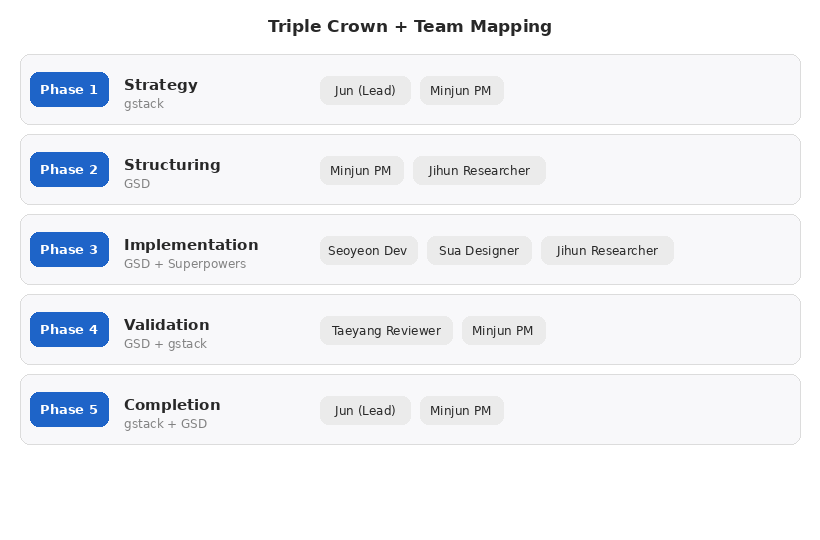
Each phase has a clear owner: – Phase 1 (Strategy): Team lead + PM set direction – Phase 2 (Structuring): PM structures project, researcher investigates tech – Phase 3 (Implementation): Developer + designer implement in parallel – Phase 4 (Validation): Reviewer checks code, PM verifies against plan – Phase 5 (Completion): Team lead deploys, PM closes out milestone
When to Use It — Application Criteria
Triple Crown doesn’t need to be applied to every task.
| Task Size | Recommended Combo | Example |
|---|---|---|
| Small (under 1 hour) | Direct, no tools | Typo fix, config change |
| Medium (half a day) | gstack only | Bug fix, small feature addition |
| Large (1–3 days) | gstack + Superpowers | New feature module, API |
| X-Large (1+ week) | Full Triple Crown | New service, major refactor |
What Running This Actually Changed
After driving real work through this pipeline, the phase that earns its keep isn’t strategy or execution — it’s validation. That’s the one everyone is tempted to skip, and it’s the one that repeatedly saved me.
The recurring failure mode with AI agents isn’t bad code. It’s plausible code. An agent finishes a task, reports it done, and the output looks right — until something downstream actually exercises it. On one recent task an agent generated a result that passed its own surface-level check but was quietly wrong in a way only a second reviewer caught before it shipped. The author agent had no idea; “done” felt true to it. The separate review pass is what turned “looks finished” into “is finished.”
That’s why the team split matters: the agent that writes the work is the worst judge of whether it’s correct. Handing validation to a different agent — reviewer checks the code, PM checks it against the original plan — removes the author’s blind spot. It’s the same reason human teams don’t let people merge their own PRs unreviewed.
The other thing that changed: smaller surface area per agent. Giving one agent the whole feature produced sprawling, hard-to-verify output. Splitting it (one owns the server handler, one the UI, one the interface between them) made each piece small enough to actually review — and the pre-agreed interface stopped the merge conflicts before they happened.
Key Takeaways
Triple Crown = “what and why” (gstack) → “in what order” (GSD) → “how well” (Superpowers)
Connect the three tools as a pipeline and you get: – Coding without direction → /cso catches it – Proceeding without a plan → GSD structures it – Chasing speed without quality → Superpowers enforces it – Thinking you’re done when you’re not → double validation blocks it
This is the workflow that moves from the era of “telling AI to write code” to the era of running an AI team.
Related Guides on Private Labs
- Mastering tmux for AI Multi-Agent Systems
- Team Automation with Claude Code: A Practical Guide
- How I Automated My Content Workflow with AI Agents
More in Problem Solving.