How to Build a Profitable AI Micro-SaaS as a Solo Developer (First $1K MRR Playbook)
How to Build a Profitable AI Micro-SaaS as a Solo Developer (First $1K MRR Playbook)
Most “make money with AI” advice stops at the demo. You wire up an API call, the output looks impressive, you post a screenshot, and then nothing happens — because a demo is not a business. A micro-SaaS is different. It’s a small, narrow, recurring-revenue product that one person can build and run. It won’t make you rich overnight, but $1,000 a month in recurring revenue from something you built alone is a very real, very achievable target. This is the honest playbook.
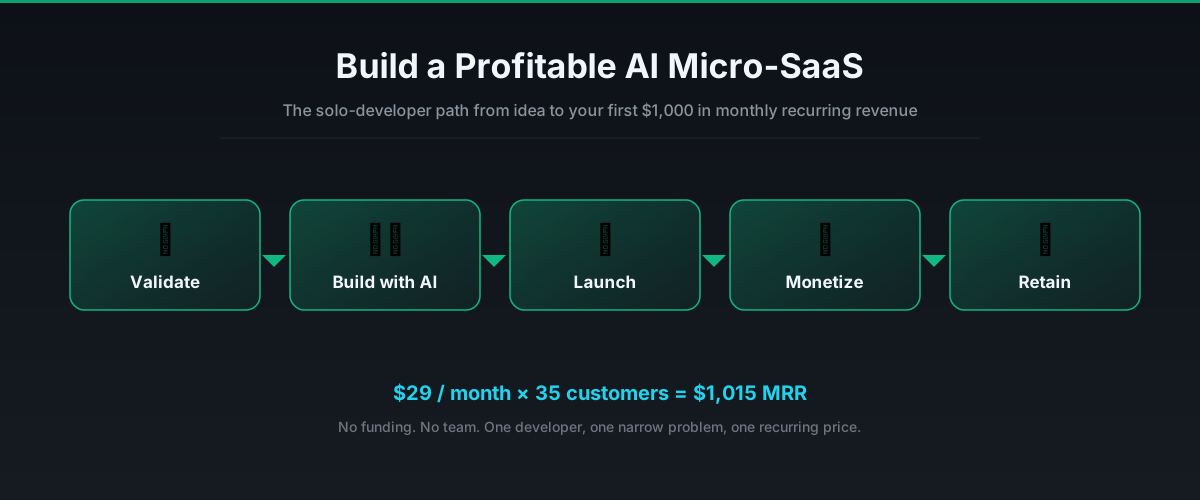
What a Micro-SaaS Actually Is
A micro-SaaS solves one narrow problem for a specific group of people, charges a recurring fee, and is small enough that a single developer can build, ship, and support it without a team or outside funding.
The “AI” part is not the product. This is the mistake that sinks most first attempts. Wrapping an LLM in a text box is not a business — anyone can do it, including your customers. The product is the workflow you remove from someone’s day. The AI is just the engine that makes that workflow cheap to build and cheap to run.
Good micro-SaaS shapes look like this: – A tool that turns messy customer reviews into a weekly summary for e-commerce store owners – A service that drafts and schedules SEO meta descriptions for small content teams – A narrow assistant that converts support tickets into a searchable internal FAQ
Notice what they share: a clear user, a recurring pain, and an output the user would otherwise pay a human to produce.
The Target: $1,000 MRR
Let’s be concrete about the goal before talking tactics.
$1,000 in monthly recurring revenue (MRR) breaks down to roughly: – 35 customers at $29/month, or – 20 customers at $49/month, or – 100 customers at $10/month (harder — low prices attract high-churn, low-commitment users)
The realistic cost side for a solo build: – Hosting (a small VPS or serverless platform): $5–$20/month – LLM API usage at this scale: $20–$80/month depending on volume – Domain + transactional email: ~$5/month – Payment processing (Stripe): ~2.9% + 30¢ per charge
At 35 customers, your infrastructure and API costs land somewhere around $60–$120/month, leaving real margin. The expensive resource is never the servers. It’s your time.
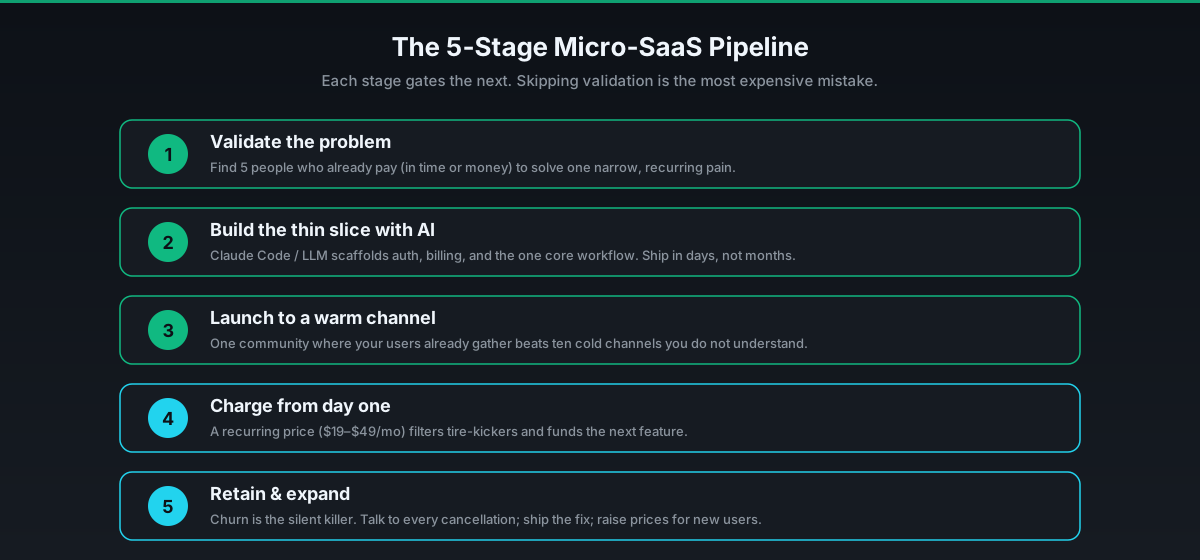
Stage 1: Validate Before You Write Code
This is the stage everyone skips and everyone regrets skipping.
Before building anything, find five people who already experience the pain you want to solve — and who already spend time or money trying to solve it. If people are paying for a clumsy workaround (a freelancer, a spreadsheet, three hours of manual work every Monday), that’s a validated problem. If they merely say “oh, that sounds cool,” that’s not validation. That’s politeness.
How to do it in a week: – Pick a niche you actually understand. Domain knowledge is your unfair advantage. You’ll know which features matter and which are noise. – Go where those people already gather: a subreddit, a Slack community, a Discord, an industry forum. – Read complaints, don’t pitch. Look for the same frustration repeated by different people. Repetition is signal. – Message 5–10 of them directly and ask how they handle the problem today. The phrase you’re hoping to hear is “ugh, it’s so annoying, I just do it manually every week.”
If you can’t find five people with the same recurring pain, the problem is too small or doesn’t exist. Better to learn that now, before you’ve spent three weekends building.
Stage 2: Build the Thin Slice With AI
Here’s where being a developer in the AI era is a genuine superpower. A coding agent like Claude Code can scaffold the boring 80% — authentication, billing integration, database schema, the deployment config — so you spend your hours on the one workflow that is your actual product.
The discipline that matters: build the thinnest slice that delivers the core outcome. Not a dashboard. Not settings pages. Not user avatars. One workflow, end to end, that a paying customer can run.
A pragmatic first-version stack for a solo dev: – A simple web framework you already know (don’t learn a new one mid-build) – A managed database (so you’re not babysitting infrastructure) – Stripe for billing — wire it in from the start, not “later” – One LLM call wrapped in proper error handling and a cost guardrail
That cost guardrail matters more than it looks. An unbounded LLM loop can quietly turn a $40 API bill into $400. A cheap defensive pattern:
MAX_TOKENS_PER_REQUEST = 4000
DAILY_SPEND_CAP_USD = 15.0

def call_model(prompt: str) -> str:
    if today_spend() >= DAILY_SPEND_CAP_USD:
        raise BudgetExceeded("daily cap hit — failing safe")
    resp = client.messages.create(
        model="claude-haiku-4-5-20251001",   # cheap model for high-volume work
        max_tokens=MAX_TOKENS_PER_REQUEST,
        messages=[{"role": "user", "content": prompt}],
    )
    record_spend(resp.usage)
    return resp.content[0].text
Use a small, fast model for high-volume routine work and reserve a larger model only for the steps that genuinely need it. Most micro-SaaS workloads do not need your most expensive model on every call — matching the model to the job is the single biggest lever on your API bill.
Aim to ship the first usable version in days, not months. If your build is dragging past a few weekends, your slice is too thick.
Stage 3: Launch to a Warm Channel
You don’t need a big audience. You need the right small one.
The community where you validated the problem is also your launch channel. The people who told you “I do this manually every week” are your first customers — go back to them first. One warm channel where your users already gather beats ten cold channels you don’t understand.
A launch that works for a nobody-knows-you solo dev: – Post a genuinely useful breakdown of the problem (not an ad) in the community where it lives. Lead with value; mention the tool at the end. – Offer the first handful of users a founding price in exchange for feedback. – Be present. Answer every question personally. Early users forgive rough edges if you’re responsive.
Expect the first launch to be quiet. That’s normal. Your job is to convert a few real users, not to go viral.
Stage 4: Charge From Day One
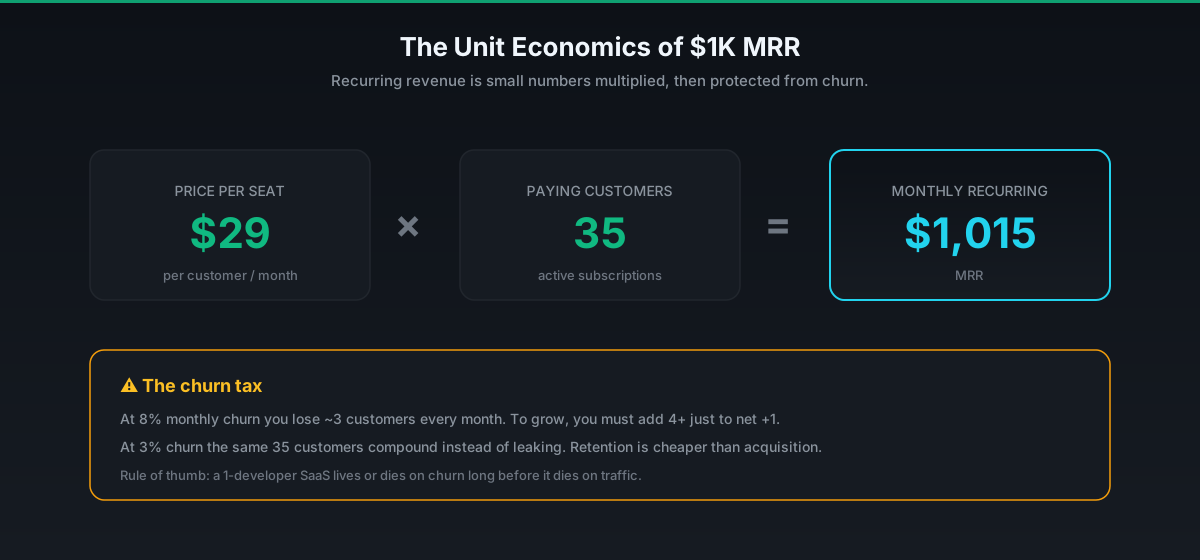
Free users are not customers — they’re a support burden that tells you nothing about willingness to pay. Charge from the first day, even if it’s a founding discount.
The math is simple and unforgiving: a recurring price multiplied by paying customers equals your MRR. $29 times 35 customers is $1,015. Pricing tips that hold up: – Price for value, not cost. If your tool saves someone three hours a week, $29/month is trivial for them. Price against the pain you remove, not your API bill. – Avoid the sub-$10 trap. Cheap plans attract the least committed, highest-churn, most demanding users. Counterintuitively, a higher price often means easier customers. – Annual plans buy you runway. A few annual subscriptions up front fund the API costs for the whole year and lock in customers past the risky first months.
Stage 5: Retain — The Stage That Decides Everything
A one-developer SaaS lives or dies on churn long before it dies on traffic.
If you lose 8% of customers every month, you’re shedding roughly three of your 35 customers monthly — meaning you have to acquire four new ones just to net a single additional subscriber. At 3% churn, those same customers compound instead of leaking away. Retention is dramatically cheaper than acquisition.
What actually moves churn: – Talk to every cancellation. A one-line “what made you leave?” email surfaces the real product gaps faster than any analytics dashboard. – Ship the fix that customers name. The feature your churned users keep asking for is your roadmap. – Make the core workflow reliable and boring. Reliability retains; novelty does not.
A Realistic Timeline
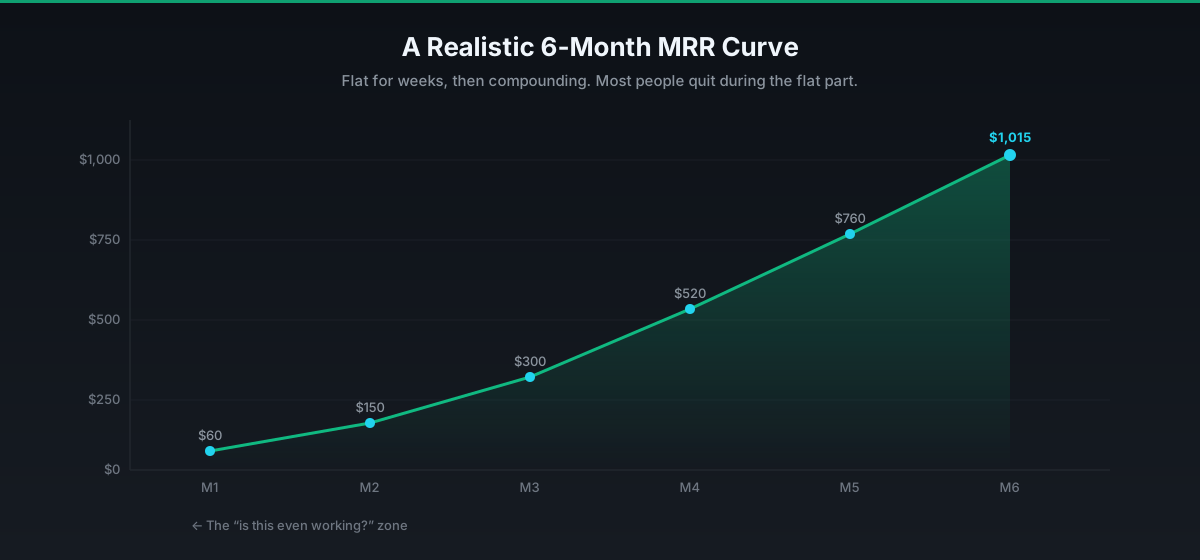
Here’s the honest shape of the first six months for someone doing this part-time alongside a job: – Month 1: $60. A handful of founding users. Mostly silence. – Month 2: $150. Word of mouth starts; you fix the most painful bugs. – Month 3: $300. The “is this even working?” zone. Most people quit right here. – Month 4: $520. The product is reliable; referrals begin compounding. – Month 5: $760. You raise prices for new users and add an annual plan. – Month 6: ~$1,015. You cross $1K MRR.
The curve is flat first and steep later. That flat part is where almost everyone gives up. Surviving it is most of the battle.
What Will Go Wrong
Let me be direct about the failure modes, because they’re predictable.
- You build before you validate. You’ll fall in love with an idea, spend a month building, launch to crickets, and discover nobody actually had the problem. This is the number one killer.
- You treat the AI as the product. A thin wrapper around an LLM has no moat and no reason to exist. The workflow and the specific user are the product.
- You never charge. “I’ll add billing once people use it” becomes a graveyard of free users who’d never have paid anyway.
- You ignore churn. Acquiring customers feels productive, so you chase new logos while the bucket leaks out the bottom.
- You quit in month three. The flat part feels like failure. It’s usually just the part before compounding kicks in.
Tips That Actually Matter
1. Pick a niche you understand. Your domain knowledge tells you which features are essential and which are decoration. This alone separates products that fit from products that flail.
2. Keep the first version embarrassingly small. If you’re not slightly embarrassed by v1, you launched too late. Thin slice, real outcome, ship it.
3. Wire billing in on day one. Retrofitting payments is painful, and free-only launches teach you nothing about willingness to pay.
4. Match the model to the job. Use a cheap, fast model for routine high-volume work; reserve the expensive model for the few steps that need it. Your margin lives here.
5. Answer every early user personally. Responsiveness buys forgiveness for rough edges and surfaces your real roadmap for free.
A profitable AI micro-SaaS isn’t a lottery ticket. It’s a narrow problem, a thin product, a recurring price, and the patience to survive the flat months. The first $1,000 MRR is the hardest. After that, you’re no longer guessing whether it works — you’re deciding how far to take it.
Related Guides on Private Labs
- 5 Ways to Make Real Money with AI Tools
- How I Made $2,000 in 30 Days Selling AI-Generated Digital Products on Gumroad
More in Make Money.